UK ETA Visa 2026 – Simple Guide and How to Apply

UK ETA Visa

The UK Electronic Travel Authorisation (ETA), also known as ETA UK, is a digital permission required by many travellers before they come to the UK. It applies to people who currently travel to the UK without applying for a visa.

The purpose of ETA UK is to allow the UK government to carry out security and immigration checks before a person travels. This means checks happen earlier, not only at the border.

From 25 February 2026, the UK ETA scheme will be fully enforced. If you need an ETA and do not have one, you may not be allowed to board your flight, train or ferry to the UK.

This guide explains what ETA UK is, who needs it, who does not need it, how to apply, and what happens if an application is refused.

What Is the UK Electronic Travel Authorisation (ETA)?

What ETA UK is designed to do

ETA UK is a pre-travel authorisation. It allows the Home Office to assess basic immigration and security information before a traveller arrives in the UK.

This system helps the UK identify potential risks early. It also allows faster processing for genuine visitors at the border.

ETA UK is not a visa

An ETA is not a visa. It does not give a right to enter the UK. It only allows a person to travel to the UK.

Final permission to enter the UK is always decided by a UK Border Force officer on arrival.

What is ETA?Digital permission to travel to the UK
Is ETA a visa?No
Maximum stayUp to 6 months per visit
Validity2 years or until passport expiry
ETA UK fee£16 per person

Why Has the UK Introduced ETA?

Strengthening UK border security

The UK government introduced ETA to improve border security. It allows checks to be completed before travel, rather than only when someone arrives at the border.

Part of a global travel system

Many countries already use similar systems. For example, the United States uses ESTA and the European Union will introduce ETIAS.

ETA UK brings the UK in line with these international practices.

Who Needs a UK ETA in 2026?

Visitors from visa-free countries

ETA UK is required for people who do not normally need a visa to visit the UK for short stays.

This includes travellers from the EU, EEA and Switzerland, as well as countries such as the USA, Canada, Australia, Japan and Brazil.

Children and family members

Every person travelling must have their own ETA, including babies and children. There are no family or group exemptions.

Who Does NOT Need a UK ETA?

British citizensNo
Irish citizensNo (limited exceptions)
UK visa holdersNo
Settled or pre-settled status holdersNo
Airside transit onlyTemporarily exempt

Some additional exemptions apply in specific situations. For example, certain school groups travelling from France and residents of the Common Travel Area may not require ETA.

Dual British or Irish Citizens

Important travel guidance

If you are a British or Irish citizen and also hold another nationality, you cannot apply for ETA UK.

From 25 February 2026, you should travel using your British or Irish passport. Travelling on another passport may result in delays, additional checks, or refusal of boarding.

What You Can and Cannot Do With a UK ETA

Permitted activities

ETA UK allows short visits for tourism, visiting family or friends, business activities, and short-term study.

It may also allow permitted paid engagements and limited work under the Creative Worker concession.

Activities not allowed

ETA UK does not allow long-term residence, paid or unpaid employment, self-employment, access to public funds, or frequent visits intended to live in the UK.

Marriage or civil partnership is not permitted. A Marriage Visitor visa must be applied for instead.

Important: Having an ETA does not guarantee entry. UK Border Force officers may refuse entry if they believe the visit is not genuine or temporary.

How to Apply for UK ETA

Step-by-step application process

Applications must be made online using the official GOV.UK website or the UK ETA mobile app.

You will need to scan your passport, complete a facial scan, answer background questions, and pay the £16 application fee.

Processing times

Most applications are decided within three working days. Many are approved sooner.

Once approved, the ETA is linked electronically to your passport. You must travel using the same passport.

What Happens If an ETA Application Is Refused?

No appeal or review

There is no right of appeal or administrative review if an ETA application is refused.

What to do after refusal

The Home Office will explain the reason for refusal. Depending on the reason, you may need to apply for a visitor visa or submit a new application.

Why Choose Kash Legal Services?

  • Specialist UK immigration advice – Focused guidance on ETA UK and visitor rules.
  • Clear and honest assessment – Simple explanations and early risk warnings.
  • Practical border experience – Advice based on real UK entry decisions.
  • Support for families and groups – Including children and complex travel histories.
  • UK-based immigration practice – Based in Sheffield, supporting clients worldwide.

Frequently Asked Questions

What is ETA UK?

ETA UK is an electronic travel authorisation required for many visa-free visitors.

Is ETA UK a visa?

No. It allows travel but does not guarantee entry.

How long does ETA UK last?

It lasts for two years or until your passport expires.

Do children need ETA UK?

Yes. Every traveller, including children, must have their own ETA.

What if I get a new passport?

You must apply for a new ETA linked to the new passport.

How Kash Legal Services Can Help

Kash Legal Services provides clear, practical and professional advice on UK ETA applications, refusals, exemptions and alternative visa options.
Disclaimer: This content is for general information only and does not constitute legal advice.

UK Spouse Visa Rules 2026: Financial Requirement, eVisa and ILR

Overview of the New Rules for Spouse Visa UK 2026

The new rules for spouse visa UK 2026 continue the direction set by earlier immigration reforms. Rather than introducing a new eligibility framework, the focus is on digital immigration systems, stricter suitability checks, and long-term settlement compliance.At Kash Legal Services we are helping with to apply spouse visa with accuracy to ensure maximum chance of success with by fulfill the rules and requirement for spouse visa uk

For applicants, this means greater emphasis on preparation, document accuracy, and understanding how the rules are applied in practice at each stage of the spouse visa route.

UK Immigration Context in 2026

Growing demand for spouse visa guidance

In recent years, there has been a noticeable increase in marriages between British nationals and overseas partners. As a result, more couples are seeking guidance on the UK spouse visa route and how upcoming changes in 2026 may affect their plans.

Policy direction and enforcement

UK immigration policy in 2026 reflects a broader focus on compliance, consistency, and digital administration. While the spouse visa route remains available, applications are assessed more closely than in previous years.

Digital Immigration Changes

Transition to digital eVisas

As part of the move toward a fully digital immigration system, physical immigration documents are being phased out. By February 2026, physical visa vignettes are expected to be replaced by digital eVisas accessed through an online UKVI account.

Electronic Travel Authorisation

From 25 February 2026, nationals of 85 visa-exempt countries, including the United States, Canada, and France, will need an Electronic Travel Authorisation before travelling to the UK. This also affects individuals visiting their partner before submitting a spouse visa application.

Financial Requirement Under the 2026 Rules

The UK spouse visa financial requirement remains at £29,000. Earlier proposals to increase the threshold to £38,700 were withdrawn and do not apply in 2026.

Where an initial spouse visa application was submitted before 11 April 2024, applicants continue to be assessed under the earlier £18,600 requirement when applying for extensions and settlement, including applications made in 2026.

Summary of Key Spouse Visa Requirements

Requirement area Position under the 2026 rules
Minimum income £29,000 for new applications; £18,600 continues for protected cases
Immigration status Digital eVisa replaces physical documents
English language A1 for entry, A2 for extension, B1 for settlement
Settlement route Five-year route continues for spouse visa holders
ILR assessment Stricter suitability checks introduced from 2026

Settlement and ILR Changes from 2026

Earned settlement model

From April 2026, wider immigration reforms may introduce an earned settlement model for many visa categories, increasing the standard qualifying period from five to ten years.

Impact on spouse visa holders

UK spouse visa holders and immediate family members of British citizens are expected to remain eligible for settlement under the existing five-year route.

Suitability checks at settlement stage

Applicants applying for Indefinite Leave to Remain from 2026 may face stricter checks, including criminal records, outstanding government debts, and compliance with immigration conditions.

Frequently Asked Questions

Have the UK spouse visa rules changed in 2026?

The rules do not introduce a complete overhaul. They continue changes introduced since 2024, with greater emphasis on digital systems, suitability checks, and settlement compliance.

What is the financial requirement for a UK spouse visa in 2026?

The financial requirement remains at £29,000 for new applications. Transitional protection continues for applicants whose initial application was submitted before 11 April 2024.

Are digital eVisas compulsory?

Yes. By February 2026, physical visa documents are expected to be replaced by digital eVisas accessed through a UKVI account.

Will spouse visas move to a ten-year settlement route?

While wider reforms may affect other routes, spouse visa holders are expected to remain on the five-year settlement route.

Have English language requirements changed?

No. A1 remains required for entry, A2 for extensions, and B1 for settlement.

Why Choose Kash Legal Services

Applying under the new rules for spouse visa UK 2026 requires careful preparation and a clear understanding of how the Immigration Rules are applied in practice.

Kash Legal Services provides UK-focused immigration guidance grounded in current Home Office policy and real-world experience of spouse visa applications, extensions, and settlement planning.

The approach focuses on accuracy, compliance, and evidence quality, helping applicants avoid common technical issues that can lead to delays or refusals.

This information is provided for general guidance only and does not constitute legal advice. Immigration rules are complex and subject to change, and individual circumstances may affect outcomes.

How Long Does a UK Spouse Visa Take ? – Processing Times Explained

UK Spouse Visa Processing Time (2026) – Inside & Outside UK | Kash Legal Services

UK Spouse Visa Processing Time (Inside & Outside UK)

Applying for a UK spouse visa can be an emotional and complex process, especially when you are waiting for a decision that affects family life, travel, employment, or settlement plans ,we not only support tp prepare an accurate application also help to understand UK comprehensive process of sposue visa without any complexity . One of the most common questions we receive at Kash Legal Services is:

“How long will my UK spouse visa take?”

The answer depends on a range of factors, including where the application is made (inside or outside the UK), whether priority or super priority services are used, and the strength and completeness of supporting evidence. In this detailed, user‑friendly guide, we explain realistic timelines, priority options, common causes of delay, and how professional legal support can help maximise your chances of a timely decision.

UK Spouse Visa Processing Timelines Explained

UK Visas and Immigration (UKVI) sets specific service standards for processing spouse visa applications, but actual timings can vary depending on workload, regional variations, case complexity, and documentation quality. Below is a clear summary or get to know about detail about provessing time for spouse visa.

Outside the UK

Spouse / Partner Visa (Entry Clearance)

  • Published service standard: Up to 12 weeks
  • Typical realistic timeframe: 4–6 months in practice
  • Regional variations: Some regions may exceed 6 months
  • Priority service option: Available (~30 working days)
Inside the UK

Spouse Visa Extension or Switch (FLR(M))

  • Published service standard: Up to 8 weeks
  • Typical timeframe: 8–12 weeks
  • Priority & Super Priority: Available (based on eligibility)
  • Section 3C leave: Extends leave if current visa expires during processing

Priority & Super Priority Services (Faster Decisions)

For applicants who need quicker decisions, the Home Office provides priority processing options. These services accelerate decision times but do not affect the substance of the decision.

Priority Service

Standard Priority Processing

  • Decision time: ~5 working days (inside UK), ~30 working days (outside UK)
  • Additional fee: ~£500
  • Key fact: Fee is non‑refundable and does not affect the outcome
Super Priority

Fastest Processing Option

  • Decision time: Next working day
  • Additional fee: ~£1,000
  • Availability: Usually for in‑country cases
  • Important: Must be selected during application submission — cannot be added later

When UKVI Starts and Ends Processing

The Home Office considers processing to start once the applicant has:

  • Attended the biometric appointment, or
  • Completed digital identity verification via the UKVI ID Check app

Processing ends when UKVI issues a formal decision by email or letter. Progress updates are generally not provided while the application remains within published standards.

Common Reasons Spouse Visa Applications Take Longer

  • Missing or incomplete evidence, such as financial documents or accommodation proof
  • Failure to meet the minimum income threshold (£29,000)
  • Insufficient proof of genuine and subsisting relationship
  • Invalid or outdated English language certificates
  • Complex immigration history, previous refusals or borderline eligibility
  • Operational backlogs, seasonal peaks or verification requirements in certain regions

Extended processing does not mean the application will be refused. In many cases, additional checks are undertaken as part of due diligence by UKVI.

What Happens if Your Visa Expires During Processing?

If you apply from inside the UK before your current leave expires, your permission to stay is automatically extended under Section 3C of the Immigration Act until a decision is made. This includes work and study permissions linked to your previous visa category.

Why Choose Kash Legal Services?

Choosing the right legal partner can make a significant difference to your spouse visa outcome and overall experience. Kash Legal Services specialises in UK family immigration, offering personalised, compliant, and strategic support to help applicants secure a timely decision.

Extensive Visa Experience

Our team has handled hundreds of spouse visa applications, giving us insight into Home Office practices and nuances.

Detailed Application Review

We carefully review your documents to minimise errors and strengthen your evidence before submission.

Clear Communication

We provide regular updates and clear guidance throughout the process, making it easier for you to plan and prepare.

Trusted Support

Our clients trust our professional approach and personal attention to detail for every application.

Frequently Asked Questions

UK Spouse Visa Fees Cost Breakdown & Payment Guide

Spouse Visa UK Fees

UK spouse visa fees in 2026 depend on where the application is made. The main application fee is £1,938 for applications outside the UK and £1,321 for applications made inside the UK, with a mandatory Immigration Health Surcharge payable separately. Kash Legal Services sheffield based immigration lawyer helps clients understand spouse visa UK fees clearly and budget accurately using official Home Office guidance.

UK Spouse Visa Fee Components

Main fee covers processing; IHS funds healthcare separately.​

  • Application Fee: £1,938 (entry clearance outside UK) funds adjudication and decision-making.
  • IHS: £2,587.50 (30 months) mandatory for all over 18; exemptions rare (e.g., diplomats).
  • Priority/Super: Optional acceleration; super priority limited to UK extensions.​
Cost Category Fee / Rate Where / When Applied Key Notes
Spouse Visa Application Fee £1,938 Outside the UK Entry clearance application; Home Office processing
Spouse Visa Application Fee £1,321 Inside the UK Extension or switching (FLR(M))
Immigration Health Surcharge (Adult) £1,035 per year Paid at online submission Mandatory; paid upfront for 30 months
Immigration Health Surcharge (Child) £776 per year Paid at online submission Applies to dependants under 18
Priority Service (Optional) Additional fee UK & Overseas Faster processing where available
Super Priority Service (Optional) Additional fee UK only Limited availability; next working day decision
Biometrics Fee Additional cost Visa centres (VFS Global) Charged at appointment booking

How do you pay for a UK spouse visa?

To submit a UK Spouse Visa application, all fees must be paid online before submission. The payment process follows these steps:

  1. Create a UKVI account and complete the online spouse visa application form.

  2. Pay the application fee and Immigration Health Surcharge (IHS) at the payment stage through the official UKVI system.

  3. Receive a payment receipt by email, which includes the reference number.

  4. Use the reference number to book the biometric appointment.

  5. Payments can be made in GBP or local currency, and debit or credit cards are accepted.

What are updates for spouse visa fees in 2026 ?

As of 2026, UK Spouse Visa fees remain unchanged following the increases in late 2025. No further fee rises have been announced by the Home Office as of January 2026, but applicants should continue to monitor official updates.

Biometric enrolment is handled by VFS Global, and additional service charges may apply depending on location and services selected after biometric processing time for spouse visa application start  and outcomes depend upon on the circumstances of individuals. .
For child applicants under 18, standard visa fees apply and proof of relationship is required.

When considering the overall cost of a UK spouse visa, it is also useful to understand the work and study rights on a UK spouse visa, as these rights apply once the visa has been granted.

UK Spouse Visa Fee Waivers and Refund Rules

UK Spouse Visa fee waivers are exceptional, and refunds are strictly limited under Home Office rules.

A fee waiver may be requested by submitting Form FW01 with evidence of destitution or risk of destitution. The waiver decision must be made before a visa application is submitted.

Refunds are available only in limited situations. The application fee may be refunded only if the application has not been submitted, and the Immigration Health Surcharge may be refunded only if biometrics have not been completed. Visa refusals or appeals do not result in refunds.

Kash Legal Services provides personalised fee guidance and payment planning to help families avoid unnecessary costs. Contact us for a free initial consultation.

.

How Applicants Can Manage UK Spouse Visa Costs?

  • Plan costs in line with UK Home Office and UKVI rules to avoid refusals and unnecessary reapplication fees.

  • Use the standard UKVI processing service where possible, as applications made outside the UK usually take up to 12 weeks, helping avoid optional priority fees.

  • Meet the financial requirement using permitted employment income or acceptable savings, as defined in the Immigration Rules, rather than relying on short-term loans.

  • Submit family applications together where eligible to manage overall costs more efficiently.

  • Seek professional advice before applying, as early legal guidance helps ensure compliance and increases the chance of first-time approval.

  • Kash Legal Services, a Sheffield-based immigration law practice, provides experienced guidance based on official Home Office requirements to help families control UK Spouse Visa costs.

How Kash Legal Services Can Help with UK Spouse Visa Fees

  • Provide clear and accurate guidance on UK Spouse Visa fees in line with UK Home Office and UKVI requirements.

  • Help clients understand all mandatory and optional charges before submitting an application.

  • Offer personalised fee assessments so families can plan and budget confidently.

  • Advise on payment stages, including application fees, Immigration Health Surcharge, and biometrics.

  • Support clients in preparing complete and compliant applications, reducing the risk of refusal and costly reapplications.

  • Assist with fee waiver assessments, where eligible, in accordance with official Home Office guidance.

Kash Legal Services, based in Sheffield, provides professional UK immigration advice focused on achieving first-time approval and smooth family reunification.

UK Spouse Visa for Asylum Seekers

Can an Asylum Seeker Apply for a UK Spouse Visa?

Asylum seekers in the UK cannot usually apply for a spouse visa while their asylum claim is pending. In limited and fact-specific circumstances, switching to the UK spouse visa route may be possible, but this requires careful legal assessment and strategy with best immigration lawyer in sheffield .

Spouse Visa Basics for Asylum Seekers and Sponsors

Any spouse visa application linked to an asylum background still follows the core Appendix FM framework.​

  • Sponsor must usually be:
    • British or Irish citizen, or
    • Settled (ILR/settled status/permanent residence), or
    • Person with protection status (refugee/humanitarian protection).​
  • Both partners must be over 18, in a genuine and subsisting relationship, intend to live together permanently in the UK, and satisfy financial, English and accommodation requirements.​

Can an Asylum Seeker Bring a Wife to the UK?

Whether an asylum seeker can bring a spouse to the UK depends largely on status (asylum pending vs refugee/humanitarian protection) and the immigration route used.​

  • If you already have refugee or humanitarian protection, you may normally use the Refugee Family Reunion rules to sponsor a spouse or partner who formed part of your family unit before you fled.​
  • If you are only an asylum seeker with a pending claim, there is no standard route to sponsor a spouse directly from abroad, because you do not yet have settled or protection status.​
  • Where your partner is British, Irish or settled in the UK, they may instead sponsor you under the Appendix FM spouse visa rules, provided all eligibility, relationship and financial criteria are met.​

Can You Switch from Asylum to Spouse Visa?

In some cases, a person who has claimed asylum can apply for leave as a spouse/partner, but this requires careful legal handling.​

  • You may be able to withdraw or vary your asylum claim and apply as a partner if you are married to, or in a genuine and subsisting relationship with, a British/Irish citizen or someone with settled/protection status in the UK.​
  • Home Office will scrutinize such applications closely; you must meet all spouse visa requirements (relationship, £29,000 financial requirement, English language, accommodation) and consider the impact on your protection case.​
  • There may be exceptional circumstances where family‑life rights under Article 8 ECHR are raised if you cannot strictly meet the rules but removal would cause unjustifiably harsh consequences.​

Applicants should review the UK spouse visa fees and cost breakdown in advance, including the application fee and Immigration Health Surcharge.

Asylum Seeker Spouse Visa Options

Characteristic Asylum Seeker Refugee / Humanitarian Protection Spouse of UK Citizen / Resident
Sponsoring spouse from abroad No standard route Yes, under Refugee Family Reunion Yes, under Appendix FM rules
Switching from asylum to spouse visa Possible with careful legal handling Not applicable Not applicable
Risks Loss of protection if refused None None
Home Office scrutiny High Standard Standard
Key requirements Meet spouse visa requirements Meet Refugee Family Reunion rules Meet Appendix FM requirements

Practical Risks and Considerations

Moving from asylum to a spouse route has legal and evidential risks that should be assessed before any application.​

  • Withdrawing asylum to apply as a spouse may leave you without protection if the spouse application is refused and appeals fail.​
  • If your relationship began after arrival in the UK, the Home Office may investigate closely for alleged “marriage of convenience”, particularly under the Marriage and Civil Partnership Referral and Investigation Scheme.​
  • Deadlines, appeal rights and possible removal action need strategic planning before changing route.​

How Kash Legal Services Can Help with  Asylum  & Spouse Visa ?

Kash Legal Services provides clear and practical advice on UK spouse and partner visa applications under Appendix FM. We help applicants understand eligibility, prepare accurate documentation, and meet relationship, financial, English language, and accommodation requirements.

All advice is based on the current Immigration Rules and Home Office guidance, with a focus on reducing the risk of refusal and avoiding unnecessary delays. Our approach is professional, structured, and client-focused, supporting families applying through the UK spouse visa route.

Summary

Immigration Position Is a UK Spouse Visa Available? Applicable Route Key Legal Points
Asylum claim pending No, in most cases Not applicable An asylum seeker does not hold settled or protection status and cannot normally sponsor or apply for a spouse visa from abroad.
Refugee status granted No (spouse visa not required) Refugee Family Reunion The relationship must have existed before the applicant fled their country of origin.
Humanitarian protection granted No (spouse visa not required) Refugee Family Reunion Similar family reunion rights apply as for refugees.
Partner is British or Irish Yes, subject to requirements Appendix FM (Spouse Visa) All relationship, financial, English language, and accommodation requirements must be met.
Partner holds settled status (ILR / settled status) Yes, subject to requirements Appendix FM (Spouse Visa) Applications involving an asylum history are closely scrutinised by the Home Office.
Switching from asylum to spouse route Possible in limited circumstances Appendix FM / Human Rights May require withdrawal or variation of the asylum claim and carries significant legal risk if refused.
Relationship formed after arrival in the UK Yes, subject to requirements Appendix FM (Spouse Visa) Refugee family reunion rules do not apply.
Exceptional circumstances Possible Article 8 ECHR Discretionary; refusal must result in unjustifiably harsh consequences.

Core Spouse Visa Requirements

Requirement Legal Standard
Sponsor status British citizen, Irish citizen, settled person, or holder of refugee or humanitarian protection status
Minimum income £29,000 per annum (subject to Immigration Rules)
English language Required unless an exemption applies
Accommodation Adequate accommodation without recourse to public funds
Relationship Genuine and subsisting, with an intention to live together permanently in the UK

Employment & Study Rights Explained for UK Spouse Visa

Can You Work on a UK Spouse Visa? Your Rights Explained

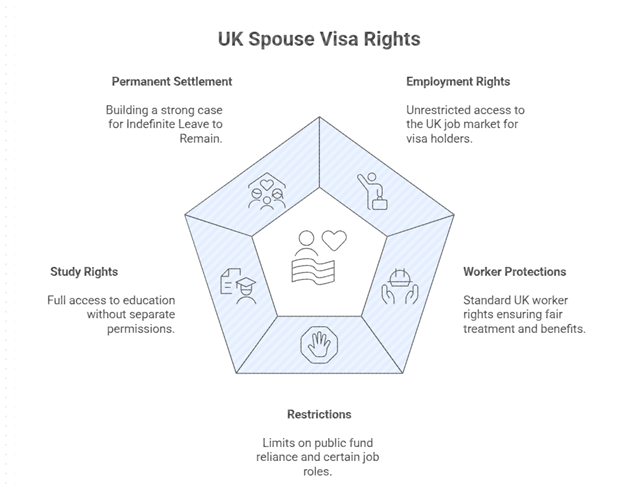
UK spouse visa holders have full rights to work in the UK, including employment, self-employment, and business activities. Under Home Office rules, these rights help families achieve financial stability and support long-term settlement.

Kash Legal Services sheffield  explains your employment and study rights, key restrictions, and how working lawfully supports future visa extensions and Indefinite Leave to Remain (ILR).By  Reading this article you should able to  know the right & restriction of spouse in uk and get  to know about the requirement process of the spouse visa .

Right of work & employment for spouse visa

Does a Spouse Visa Allow You to Work?

Spouse visa grants unrestricted access to the UK job market without sponsorship or hour limits. Holders can pursue employment, self-employment, or business ventures across all sectors.​

  • Take any paid role, from professional to manual labor.
  • Operate as self-employed or director, with income counting toward visa extensions.
  • No restrictions on profession, unlike skilled worker visas.​

Employment Rights Explained

Visa holders enjoy standard UK worker protections, supporting long-term settlement goals. Earnings help meet financial requirements for extensions or Indefinite Leave to Remain (ILR).​

  • Eligible for minimum wage, paid holidays, and maternity/paternity leave.
  • Protected against discrimination under Equality Act 2010.
  • Must comply with taxes, self-employed file Self-Assessment annually.​

Key Restrictions on spouse visa 

Certain limits prevent public fund reliance and ensure visa integrity. Breaches can lead to curtailment or refusal of future applications.​

  • Cannot claim most benefits like Universal Credit or housing support.
  • No professional sportsperson roles (Byelaws exception).
  • Fiancé(e) visa holders cannot work during the 6-month stay.​

Can You Study on a Spouse Visa UK?

Full study rights apply, allowing enrollment in any course without separate permission. Publicly funded higher education remains accessible.​

  • Pursue degrees, vocational training, or short courses at universities/colleges.
  • Access student loans/loans if eligible; no course level limits.
  • Children of holders get state school places automatically.​

Although a UK spouse visa allows work and study, approval depends on meeting key conditions, including the English language requirement for a spouse visa.

Path to Permanent Settlement

Maintaining work/study builds a strong 5-year ILR case, with ongoing proof of finances and relationship. Extend visa 28 days before expiry to preserve rights seamlessly.​

Contact Kash Legal Services for application support, document checks, and ILR strategies tailored to Indian applicants. Refer to gov.uk/uk-family-visa/partner-spouse for official .

Key points

Category What Is Allowed / Required
Right to Work UK spouse visa holders can work in any job without sponsorship or hourly limits.
Types of Employment Professional roles, skilled jobs, manual labour, part-time or full-time work.
Self-Employment Permitted to work as self-employed, freelancer, or company director.
Business Activities Allowed to start, own, or run a business in the UK.
Income Use Earnings can be used for visa extensions and ILR financial requirements.
Employment Protections Minimum wage, paid holidays, maternity/paternity leave, and rest breaks apply.
Discrimination Protection Protected under the Equality Act 2010 like UK workers.
Tax Obligations PAYE for employees; self-employed must register with HMRC and file Self-Assessment annually.
Right to Work Checks Employers must verify status using BRP or online Home Office system.
Public Funds Cannot claim most benefits, including Universal Credit or housing support.
Restricted Roles Cannot work as a professional sportsperson (limited exceptions).
Fiancé(e) Visa Rule Fiancé(e) visa holders cannot work during the 6-month visa period.
Right to Study Full study rights – degrees, vocational courses, or short courses allowed.
Education Access Eligible for publicly funded education if requirements are met.
Children’s Education Children can attend UK state schools automatically.
Settlement (ILR) Lawful work and study support the 5-year route to ILR.
Visa Extension Timing Apply up to 28 days before expiry to maintain continuous rights.

How Kash Legal Services Can Help

Understanding your work rights on a UK spouse visa is important, but applying the rules correctly is just as important. At Kash Legal Services, we support clients at every stage of the spouse visa process, from initial applications through to long-term settlement.

We have practical experience advising spouse visa holders on employment, self-employment, and compliance with Home Office requirements. Our advice is based not only on the Immigration Rules, but also on how those rules are applied in practice by the Home Office.

Our Services Include:

  • UK spouse visa applications
    Careful preparation and checking of documents to ensure they meet current Home Office guidance.

  • Employment and financial guidance
    Advice on using salaried income, self-employment earnings, business income, and tax records for visa extensions and ILR.

  • Compliance support
    Helping clients avoid common issues relating to work conditions, tax obligations, and public funds restrictions.

  • Visa extensions and ILR planning
    Long-term planning to protect continuous residence and strengthen settlement applications.

  • Clear and honest advice
    No guarantees or unrealistic promises — only advice based on current UK immigration law and official gov.uk guidance.

We focus on accuracy, compliance, and protecting your future immigration status in the UK. Where appropriate, we always refer clients to official Home Office guidance on gov.uk and ensure our advice remains fully aligned with current policy.

English Test for UK Spouse Visa Extension

Which English test is required for a UK spouse visa extension?

Meeting the English language requirement at A2 level for a spouse visa extension can be confusing, and many applicants choose to seek guidance from an experienced immigration lawyer in Sheffield to ensure the correct test and evidence are submitted also provide clear guidance about spouse visa process briefly .

For a standard 5 year partner route (spouse visa) extension

You must show at least A2 CEFR in speaking and listening at the time of the FLR(M) application, if this is your first extension after around 2.5 years in the UK.

If you previously passed an English test at A2 or higher (B1–C2) with an approved SELT provider for a successful earlier partner application, you can normally reuse that result at extension, provided the test is still on the UKVI approved list and has a valid SELT URN.

The test must be a Secure English Language Test (SELT) taken at a Home Officeapproved test centre and you must include the SELT unique reference number (URN) in your application.

A1 English test for UK Spouse visa

The A1 English test applies mainly to firsttime spouse/partner visa applicants, not to the standard extension, but it is closely linked and important for longterm planning.


Stage / Situation English Level Required Who It Applies To Test Type & Conditions Accepted Examples / Notes
First spouse visa application A1 CEFR First-time spouse/partner applicants Must pass a SELT at a Home Office-approved test centre IELTS Life Skills A1, LanguageCert A1 SELT, Trinity GESE Grade 2
First spouse visa extension (5-year route) A2 CEFR Applicants extending after about 2.5 years in the UK Speaking & listening only; SELT required; include SELT URN with FLR(M) IELTS Life Skills A2; LanguageCert International ESOL SELT A2 (Speaking & Listening); Trinity GESE Grade 3 (A2) – SELT for UKVI (UK test centers); Skills for English UKVI A2 (PSI); Pearson PTE Home A2
Reusing a previous English test A2 or higher (B1–C2) Applicants who passed an approved test for an earlier partner application Test must still be on the UKVI approved list and have a valid SELT URN No need to retake if conditions are met
Later application for ILR B1 CEFR Partners applying for Indefinite Leave to Remain Must also pass the Life in the UK Test Some applicants choose to sit B1 early for long-term planning
Test format requirement All spouse visa stages Secure English Language Test (SELT) only Non-UKVI English tests are not accepted
Skills assessed All SELT tests for spouse visas Speaking and listening only Reading and writing not required

Does a spouse need English test  in the UK?

The Immigration Rules do not insist on “IELTS Academic” or “IELTS General Training” specifically, but they do require an approved SELT at the correct CEFR level; several SELT brands include “IELTS” in their name.

Important distinctions:

For spouse/partner visas, the Home Office only tests speaking and listening, so the most common choice is IELTS Life Skills (A1, A2 or B1) – a SELT version designed for family visas, ILR and citizenship.

Standard (nonUKVI) IELTS Academic or General Training certificates without a SELT URN are not accepted for spouse visas, even if the scores are high.

Where applicants need a fourskill test for work or study as well as family immigration, they may use IELTS for UKVI (Academic or General Training) or another fourskill UKVI SELT, but this is usually more than is required for a spouse visa alone.

It is also important to understand whether asylum seekers can apply for a spouse visa in the UK, as the rules are different from standard applications

Who is exempt from the English test for a UK spouse visa extension?

Under Home Office policy, some applicants are exempt from the English language test requirement for a spouse/partner application or extension. You may not need to take a new English test if any of the following applies:

  • Age or medical exemption: You are under 18 or over 65, or you have a long-term physical or mental condition that makes learning English or taking the test unreasonable (you will normally need medical evidence).

  • Nationality exemption: You are a citizen of a majority English-speaking country (for example, the USA, Canada, Australia, New Zealand, or certain Caribbean countries) and you can prove this with your passport.

  • Degree taught in English: You have a degree-level qualification taught or researched in English, either in the UK or overseas, with Ecctis (formerly UK NARIC) confirmation that it is equivalent to a UK bachelor’s degree or higher.

  • Completed 5 years on a family route: You are already in the UK and have completed 5 years on a family visa as a partner or parent and are now applying to extend; in these cases, further English testing may not be required.

There are some new rules for spouse visa 2026 that may effect  the scnerio. Get free  consultation Kash legal services to understand the rule and regulation according to 2026.

Key points for English requirement for extension:

  • For an initial UK spouse/partner visa under Appendix FM (entry clearance from abroad or first in country FLR(M)), you must usually pass an approved English test at minimum A1 CEFR in speaking and listening.
  • The test used must be a SELT from an approved provider (for example IELTS Life Skills A1, Language Cert A1 SELT, or Trinity GESE Grade 2), taken at a Home Officeapproved test center listed on the UKVI SELT guidance.
  • If your English is strong enough, you can choose to sit A2 or B1 at the first application; doing so can make it easier to reuse the same result for your future spouse visa extension, subject to current rules and approvedtest lists at that time.
  • For Kash Legal Services clients, assessing whether to take A1 only or a higher level at the start is part of strategic planning for the full 5year spouse route to ILR.

How Kash Legal Services Helps with Spouse Visa Extensions

Kash Legal Services provides clear and reliable support for spouse visa extensions, with advice based on current Home Office guidance and practical immigration law experience. We help clients identify the correct English test or exemption, ensure the right evidence is submitted, and prepare applications in a clear and compliant manner, reducing stress and the risk of refusal.

UK Partner Visa Applications: Navigating Exceptional Circumstances

Understanding Exceptional Circumstances in Spouse or Partner Visa Applications

When someone wants to bring their spouse or partner to the UK, they usually need to meet certain rules called Appendix FM. These rules include financial requirements, proof of a genuine relationship, and sometimes English language skills. But what happens if the sponsor cannot meet these rules? This is where “exceptional circumstances” come into play.

What Are Exceptional Circumstances?

Exceptional circumstances mean special situations where the usual rules cannot be met, but refusing the visa would cause very serious problems for the applicant or their family. This is linked to Article 8 of the European Convention on Human Rights, which protects the right to family and private life.

To succeed under exceptional circumstances, the applicant must prove that refusing their visa would lead to “unjustifiably harsh consequences.” This is a high standard it’s not enough to show that the situation is difficult or unusual.

What Rules Still Apply?

Even if you apply under exceptional circumstances, you must still meet some basic rules:

  • The relationship between the applicant and sponsor must be genuine.
  • The applicant must be suitable to enter or stay in the UK (no serious criminal history or deportation orders).
  • Some eligibility criteria like relationship proof and accommodation must be met.

However, financial and English language requirements can sometimes be waived if exceptional circumstances are proven.

Financial Requirements and Exceptions

Normally, sponsors must earn a minimum income (£18,600 or £29,000 depending on the application date) to bring their partner to the UK. If they don’t meet this, they can try to use other sources of income, such as:

  • Financial support from a third party (like a family member).
  • Future earnings from employment or self-employment.
  • Other reliable sources of income or funds.

But the Home Office will only consider these if refusing the visa would cause very serious hardship.

Other Exceptions

If the sponsor and applicant meet financial requirements but fail other parts of Appendix FM, they can still apply under exceptional circumstances. The Home Office will look at whether refusal would cause harsh consequences for the applicant, their partner, or children involved.

If children are involved, their best interests must be a primary consideration.

Examples of Exceptional Circumstances

  • A partner caring for a child with special needs who cannot move abroad.
  • A couple facing serious religious persecution if forced to live outside the UK.
  • A sponsor with refugee status who cannot return to their home country.

What Does “Insurmountable Obstacles” Mean?

For partners applying to stay in the UK, if there are “insurmountable obstacles” to living together outside the UK, the Home Office may grant leave. This means very serious difficulties or hardships that cannot be overcome.

What Happens If Your Application Is Successful?

If granted leave under exceptional circumstances:

  • The applicant usually gets leave for 30 or 33 months.
  • They must wait 10 years before applying for indefinite leave to remain (settlement), instead of the usual 5 years.
  • They cannot claim public funds but can work.
  • Later, if they meet all normal requirements, they can switch to the 5-year route to settlement.

Final Thoughts

Applying under exceptional circumstances is challenging and requires strong evidence. It is important to show that refusal would cause serious harm, not just inconvenience. Kash Legal Services can help you prepare a strong application by gathering the right evidence and explaining your situation clearly.

If you or your partner face difficulties meeting the usual visa rules, don’t lose hope. Exceptional circumstances may provide a way to stay together in the UK. For expert advice and support with your spouse or partner visa application, contact Kash Legal Services today.

Bittersweet Victory: Man Wins UK Spouse Visa Appeal Too Late

In a recent case, a man named Mr. Tomlinson faced a heartbreaking situation after winning his appeal for a UK spouse visa. This case, known as R (Tomlinson) v Secretary of State for the Home Department [2025] EWCA Civ, highlights the challenges many face in the immigration system.

Mr. Tomlinson applied for a visa to join his wife in the UK. Unfortunately, his application was denied, leaving him separated from his loved one. He decided to appeal the decision, hoping to reunite with his wife. After a long wait, the Court of Appeal finally ruled in his favor, granting him the right to enter the UK as a spouse.

However, this victory came with a heavy heart. By the time the court made its decision, Mr. Tomlinson’s wife had tragically passed away. This meant that while he won the legal battle, the emotional toll was immense. The victory was bittersweet, as it could not bring back the love he had lost.

The case revolved around Mr. Tomlinson, a Jamaican national who had previously overstayed his visa and faced deportation. After marrying a British citizen, he applied for a spouse visa to join her in the UK. His application was initially denied due to his past criminal conviction, leading him to appeal the decision. The Court of Appeal ultimately ruled in his favor, stating that the Home Office had failed to consider a previous tribunal’s findings regarding his circumstances.

This case serves as a reminder of the complexities and emotional struggles involved in immigration processes. Many people like Mr. Tomlinson face long waits and uncertainty, which can have devastating effects on their lives and relationships.

At Kash Legal Services, we understand the importance of timely and compassionate support in immigration matters. We strive to help individuals navigate the system and achieve their goals. If you or someone you know is facing challenges with immigration or visa applications, please reach out to us. We are here to help you every step of the way.

Spouse visa UK- New family immigration visa rules ‘penalise couples’

Spouse visaUK – The new family immigration  Spouse visa rules in the UK have raised concerns about the separation of couples who wish to reunite in the country. As of April 11th, 2024, anyone applying for a visa to bring a loved one from overseas must earn at least £29,000 per year, a significant increase from the previous minimum income requirement of £18,600. This change will make it much harder for low-income families to reunite, potentially leading to separation and hardship. The new  Spouse visa rules apply to the spouse already living in the UK, and the minimum income requirement will increase further to £38,700 by next spring. This is significantly higher than the average salary in the UK, which is around £27,000 per year.

The UK’s ranking for ease of family reunion has also dropped, with the country now second from bottom among 56 countries, according to the Migrant Integration Policy Index. This highlights the challenges that families face when trying to reunite in the UK. The Home Office has defended the new  Spouse visa rules, stating that they are necessary to reduce net migration and prevent abuse of the system. However, critics argue that the rules are too restrictive and discriminatory, particularly towards low-income families and women. The new rules will have a significant impact on families living in the UK and abroad, who may be separated by the introduction of the minimum salary level. It is essential that the government considers the impact of these rules on families and takes steps to ensure that they are not unnecessarily separated. To conclude, the new family immigration visa rules in the UK are causing concern for families who want to reunite. The significant increase in the minimum salary requirement for  Spouse visa will make it much harder for low-income families to reunite, potentially leading to separation and hardship. The government must consider the impact of these rules on families and take steps to ensure that they are not unnecessarily separated. At Kash Legal Services, as UK immigration lawyers, we are dedicated to advocating for the rights of families affected by these regulations..